
Download this resouce by completing the form below
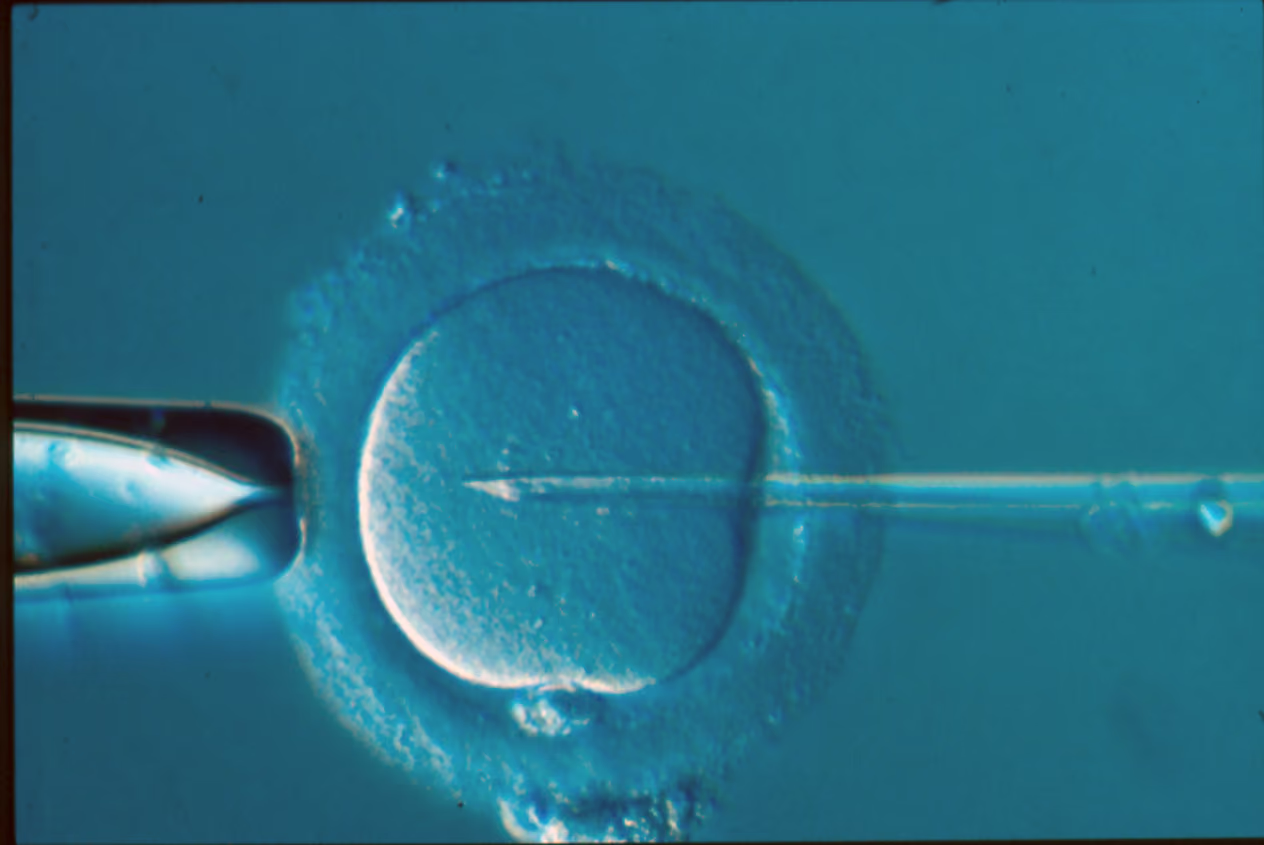
Automated, digitally controlled ICSI has resulted in live births, showing that robotic systems can perform or remotely control delicate laboratory steps. It is an important proof of concept, not proof that automation is safer, more effective or more accessible than standard ICSI. The first report involved five eggs in the automated group, and later research remained small. Patients should ask whether a system is experimental, who controls it and what outcome evidence supports its use.
What is ICSI?
Intracytoplasmic sperm injection, or ICSI, is performed as part of IVF. An embryologist selects a sperm and injects it directly into an egg. It may be recommended for a very low sperm count, poor motility or morphology, surgically retrieved sperm, or previous failed or very low fertilisation.
ICSI helps sperm and egg meet, but it does not guarantee fertilisation, embryo development, implantation or live birth. The HFEA says there is currently no scientific evidence supporting routine ICSI when infertility is not related to a sperm problem.
What happened in the first automated-ICSI live-birth report?
A 2025 case report described a workstation designed to automate the 23 micromanipulation steps used for each egg. Five donor eggs were assigned to the automated system and three to manual ICSI.
Four of five eggs in the automated group fertilised, compared with three of three in the manual group. Each group produced two usable blastocysts. A fresh transfer from the automated group did not result in pregnancy; a later frozen-thawed blastocyst transfer resulted in a healthy live birth at 38 weeks.
The remote operator was approximately 3,700 km away. This demonstrated feasibility, but a single live birth cannot establish comparative safety or effectiveness.
Was the process really “fully automated”?
The workstation was capable of automating the complete micromanipulation workflow, but the reported procedure was not independent of people.
Across 115 micromanipulation steps for five eggs, 49.6% were completed autonomously. The rest were initiated or controlled digitally by a remote operator. On-site staff were needed for setup and once for troubleshooting. Human embryologists and clinicians also remained responsible for the wider IVF process, embryo assessment, transfer and patient care.
“Automated”, “digitally controlled” and “autonomous” are not interchangeable:
Automated
- Meaning in this research: The system follows programmed steps within set parameters
Digitally controlled
- Meaning in this research: A person directs robotic actions through an interface
Autonomous task
- Meaning in this research: The system completes a defined task without human intervention after initiation
Fully autonomous IVF
- Meaning in this research: Not what the first case report demonstrated
Headlines should therefore avoid implying that an AI system independently managed an entire IVF cycle.
What did later research add?
A later proof-of-concept study reported automated systems for sperm preparation, finding and denuding eggs, and ICSI. Eleven patients contributed cycles in which combinations of these systems were used.
The automated arms recorded 45 fertilisations from 70 eggs and 19 usable blastocysts from 45 zygotes. The manual comparisons recorded 47 fertilisations from 58 eggs and 28 usable blastocysts from 47 zygotes. Five live births followed 12 single frozen-blastocyst transfers in the automated arm.
These results expand the feasibility evidence, but the study was not designed or large enough to prove superiority. Different combinations of systems were used, the sample was small and laboratory and patient factors can affect outcomes. The correct conclusion is that clinical translation is being explored, not that automated treatment now outperforms embryologists.
Does automated ICSI improve success rates?
We do not yet know. The early studies report technical and reproductive outcomes in small groups. They do not establish that automation increases cumulative live-birth rates, reduces miscarriage, improves child health or works better for particular forms of male infertility.
The first automated procedure also took an average of 9 minutes 56 seconds per egg, longer than routine manual ICSI according to the authors. Efficiency may change as systems develop, but future projections are not current patient benefits.
Could automation improve access or consistency?
Potential advantages include standardising some laboratory movements, recording detailed process data, reducing repetitive manual work and allowing expert input at a distance. Those are plausible uses that require evaluation in real clinics.
Remote operation does not by itself create local IVF capacity. A clinic still needs licensed facilities, trained on-site staff, safe handling systems, reliable technology, cybersecurity, contingency plans and appropriate clinical governance. Cost and access effects are not established.
What are the unanswered questions?
- How do fertilisation, blastocyst, cumulative live-birth and complication rates compare in large, independent trials?
- Which patients, if any, benefit more than with manual ICSI?
- How are rare errors detected and managed?
- What happens if connectivity, software or hardware fails?
- How are patient and embryo data secured?
- Who is accountable for a remote or autonomous decision?
- What training and licensing should operators and clinics require?
- Is the technology cost-effective?
- What long-term follow-up is available for children born after these procedures?
Were there conflicts of interest?
Readers should know that many authors of the first case report declared roles, shares, patents, employment or consultancy relationships with the company developing the system. A declared conflict does not invalidate research, but it increases the importance of replication by independent teams and transparent comparative evidence.
What should a patient ask a clinic?
- Is this system part of research, routine care or a paid add-on?
- Has the UK regulator licensed its use at this clinic?
- Why is ICSI recommended for our diagnosis?
- What outcome evidence applies to patients like us?
- Who selects the sperm and who can override the system?
- What happens if the equipment or connection fails?
- Is there an additional charge, and is there evidence it improves live birth?
- How will our data be used to train or evaluate software?
In the UK, patients can check whether a clinic is HFEA-licensed and should receive clear information about experimental procedures, consent, costs and alternatives.
What does this mean for men with infertility now?
The research is technically significant and may shape future laboratories. It does not change the principle that treatment should be based on an individual diagnosis, evidence and informed consent.
Men are not made more central to care merely because a machine selects or injects sperm. Inclusive care also requires understandable results, access to andrology expertise, involvement in decisions and emotional support. Technology should be judged by whether it improves safe, meaningful outcomes for patients, not by novelty alone.
Related Male Fertility Hub resources
- Link to IVF vs ICSI Explained.
- Link to IVF for Men.
- Link to IVF Treatment Add-ons: What the Evidence Shows.
- Link to Semen Analysis Results Explained.
Related articles
- IVF Explained: Everything Men Need to Know
- IVF Add Ons Explained with Professor Tim Child, Evidence You Can Trust
- NHS Fertility Funding for Men Explained with Anne Howard
Sources
- Mendizabal-Ruiz G et al. A digitally controlled, remotely operated ICSI system: case report of the first live birth. Reproductive BioMedicine Online. 2025;50(5):104943.
https://doi.org/10.1016/j.rbmo.2025.104943 - Mendizabal-Ruiz G et al. Automated oocyte retrieval, denudation, sperm preparation, and ICSI in the IVF laboratory: a proof-of-concept study and report of the first live births. Human Reproduction. 2026;41(2):214–229.
https://doi.org/10.1093/humrep/deaf240 - HFEA: Intracytoplasmic sperm injection (ICSI)
https://www.hfea.gov.uk/treatments/explore-all-treatments/intracytoplasmic-sperm-injection-icsi/
This article explains emerging research and is not a recommendation for a particular clinic, system or treatment.