
Download this resouce by completing the form below
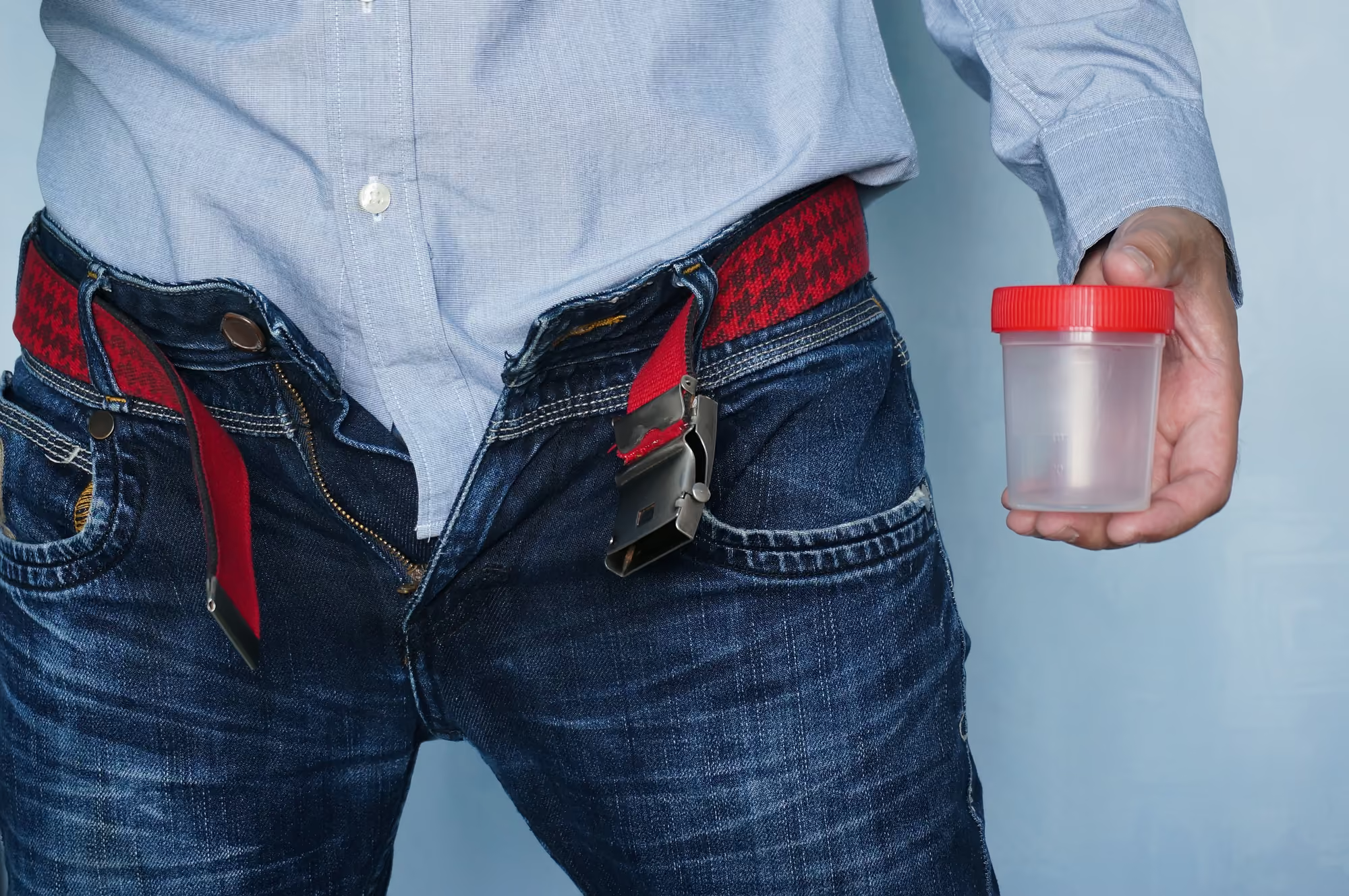
Home sperm tests vary widely. Some provide a limited screening result for sperm concentration or motility, while home-collection services send the sample to a laboratory for broader analysis. A limited kit cannot rule out problems it does not measure, predict future fertility or replace clinical assessment when you have symptoms, medical risks or difficulty conceiving.
What is a home sperm test?
“Home sperm test” can describe two different services:
A self-test used and read at home
You produce a semen sample, follow the kit instructions and receive a result through a device, colour change, reader, phone or app. The kit may estimate one or two measurements and classify the result against its own threshold.
A home-collection service with laboratory analysis
You collect the sample at home and send or deliver it to a laboratory. The laboratory may perform several parts of a diagnostic semen analysis and provide a report or professional consultation.
These services are not equivalent. Before buying, identify where analysis happens, which measurements are included and whether collection and transport conditions allow a meaningful result.
What can a home sperm test measure?
Depending on the product, a test may report:
- Sperm concentration
- Total sperm number
- Motility or a form of motile sperm concentration
- Semen volume
- Morphology
- Vitality
- Other laboratory observations
Many instant kits do not measure the full set. A result showing that sperm concentration is above a threshold says nothing about morphology if morphology was not assessed.
Some marketing uses “sperm count” when the device actually reports concentration or a positive/negative classification. Read the technical description, not only the product name.
How is a clinical semen analysis different?
A diagnostic semen analysis is performed by an appropriate andrology laboratory using standardised methods and quality controls. It can assess the sample as a whole and provide clinical reference values.
- Limited home self-test: Often reports one or two measurements
- Diagnostic laboratory semen analysis: Assesses concentration, total number, motility, morphology and other relevant features
- Limited home self-test: May give a category rather than the raw result
- Diagnostic laboratory semen analysis: Provides a detailed report with units, methods and laboratory comments
- Limited home self-test: User performs key steps and interprets the result
- Diagnostic laboratory semen analysis: Trained laboratory staff process and examine the sample
- Limited home self-test: May be sensitive to lighting, phone compatibility, timing or technique
- Diagnostic laboratory semen analysis: Uses validated laboratory equipment, quality control and trained interpretation
- Limited home self-test: Usually cannot investigate the cause of an abnormal result
- Diagnostic laboratory semen analysis: Fits into a clinical pathway for repeat testing and further investigation
A laboratory analysis still cannot provide a simple fertile or infertile verdict. The World Health Organization describes semen analysis as one part of clinical assessment, and an abnormal result normally needs confirmation.
Are home sperm tests accurate?
Accuracy depends on the exact product, the measurement and how it was validated. A kit can perform reasonably for its intended limited purpose while remaining unsuitable as a full fertility assessment.
Check for evidence of:
- Independent validation against an appropriate laboratory method
- Sensitivity and specificity around the decision threshold
- Repeatability when the same sample is tested
- Clear instructions and failure messages
- Performance in ordinary home users, not only trained researchers
- Regulation as a medical device for the intended self-test use
- The exact smartphone models, operating systems or accessories required
A high percentage in an advert may refer to agreement for one threshold rather than accuracy across all clinically relevant values.
What can a reassuring home result miss?
It can miss:
- Low motility if only concentration is measured
- Abnormal morphology
- Low total sperm number caused by low semen volume
- Azoospermia below the device’s detection limit
- White blood cells or other laboratory observations
- Collection or transport problems
- Hormonal, genetic, testicular or obstructive causes
- Changes between samples
It also cannot assess the fertility of your partner or the chance of pregnancy as a couple.
A green tick or “normal” category should not delay clinical assessment after a year of trying to conceive, after six months when the female partner is aged 36 or over, or when there is a known concern.
Can an abnormal home result mean you are infertile?
No. A screening result below a threshold is not a diagnosis. Semen measurements vary, and collection conditions can materially affect the result.
After an abnormal home test:
- Check whether the full sample was collected and the instructions were followed.
- Save the exact result, device name, lot number and date.
- Contact your GP or an appropriate fertility or andrology service.
- Arrange a diagnostic laboratory semen analysis.
- Do not start supplements, hormones or another treatment solely from the home result.
The 2026 NICE guideline recommends a repeat confirmatory semen analysis when the first clinical result is abnormal, ideally about three months later. A repeat should happen sooner for azoospermia or severe oligozoospermia.
Should every young man test his sperm?
There is no UK national recommendation for routine semen screening of all men at 18 or in their early twenties. The original article presents this as an expert debate prompted by a newspaper report, not established screening policy.
Routine screening raises unresolved questions:
- What test and threshold should be used?
- How well does one result predict fertility many years later?
- Which finding has an effective early intervention?
- How should false reassurance and unnecessary anxiety be managed?
- Who provides follow-up and pays for confirmation?
A semen analysis is a snapshot. Sperm production can change with illness, medication, testosterone, anabolic steroids, treatment and age. A normal result at 20 does not guarantee fertility at 35, and an abnormal result does not prove that future parenthood is impossible.
Testing earlier may be reasonable when there is a clinical concern, such as previous undescended testicles, chemotherapy, testicular injury, a varicocele, hormonal symptoms, a genetic condition or testosterone use. Discuss the purpose and follow-up with a clinician.
Can a home test detect a varicocele?
No. A home sperm test may identify a semen measurement that needs confirmation, but it cannot diagnose a varicocele. Diagnosis normally involves a physical examination, sometimes supported by ultrasound.
Many varicoceles do not require treatment. The 2026 NICE fertility guideline says repair can be considered for men with a varicocele detected on clinical examination who are trying to conceive spontaneously and have reduced semen parameters, taking the female partner’s fertility into account.
Read Varicocele and Male Fertility for the assessment and treatment criteria.
Is producing a sample at home better than at a clinic?
Some men find home collection less pressured and more private. This can make it easier to produce a complete sample. However, home collection introduces time, temperature, transport and identification requirements.
If a clinic or laboratory accepts home samples, follow its instructions on:
- The approved sterile container
- The abstinence period
- Washing and collection
- Avoiding ordinary lubricants and condoms
- Recording the production time
- Keeping the sample at the required temperature
- Delivering it within the stated window
Do not assume a postal service preserves every parameter. Ask which measurements remain valid after the expected transport time.
How do you choose a home sperm test?
Before paying, ask:
- Is this a self-test or a home-collection laboratory service?
- Which exact measurements and units will I receive?
- Which important semen parameters are not included?
- Is the device appropriately conformity-marked for the UK market and specifically intended for self-testing?
- Who is the manufacturer, and can I see the instructions before buying?
- What independent validation has been published?
- How are sample temperature and timing controlled?
- Is the laboratory appropriately accredited for the tests it reports?
- Who explains an abnormal or uncertain result?
- How quickly can I access a clinical confirmatory test?
- What happens to my sample and personal data?
Buy medical devices from a reputable source. Do not use a damaged, unsealed or expired kit. Suspected device problems can be reported to the MHRA through the Yellow Card scheme.
What about privacy and sperm-test apps?
A sperm-test service may collect health information, video or image data, payment details and information about your partner. Read:
- The privacy notice
- Whether analysis occurs on your phone or a remote server
- Whether images are stored
- Who can access or reuse de-identified data
- Whether data leave the UK
- How to request deletion
- What happens if the company closes
Privacy claims such as “anonymous” or “secure” should be supported by specific information, not assumed from a discreet delivery box.
When should you go directly to a GP or clinic?
Do not rely on a home kit first if you have:
- A testicular lump, swelling, significant pain or injury
- Problems with erections or ejaculation
- Previous chemotherapy, radiotherapy or pelvic surgery
- Undescended testicles or previous testicular torsion or infection
- Testosterone treatment or anabolic-steroid use
- A known genetic or hormonal condition
- Difficulty conceiving that already meets the NHS assessment criteria
- A previous abnormal semen analysis
Sudden severe testicular pain needs urgent medical assessment.
Questions to ask after any sperm test
- Which measurements were actually tested?
- Can I have the complete result with units and reference values?
- Were the collection and transport conditions valid?
- Does this need confirmation in an andrology laboratory?
- If the clinical result is abnormal, when should it be repeated?
- Do my history or symptoms indicate a physical examination or hormone tests?
- Who will explain possible causes and the next step?
The most important thing to remember
A home sperm test can be a convenient screening step, but its value depends on what it measures and what happens next. Do not treat a limited “normal” result as proof of fertility or an abnormal result as a diagnosis. Choose a legitimate product, understand its gaps and use a clinical semen analysis when the outcome matters.
The original article includes perspectives from Professor Allan Pacey and Mr Tet Yap on access, anxiety, home collection and follow-up. Any quotation or personal recommendation attributed to them should be checked against the original recording or publication and approved before republishing.
For a broader testing guide, read How to Check Your Sperm Health, or join The Male Fertility Hub community for support.
Related articles
- Semen Analysis Explained with Andrologist Stuart Dawe Long
- Male Fertility Testing Through Your GP: What to Expect
- The Waiting Game: How Abstinence Timing Affects Male Fertility Testing
Sources
- NICE guideline NG257: Investigation of fertility problems
https://www.nice.org.uk/guidance/ng257/chapter/Investigation-of-fertility-problems-and-management-strategies - World Health Organization: WHO laboratory manual for the examination and processing of human semen
https://www.who.int/publications/i/item/9789240030787 - NHS: Low sperm count
https://www.nhs.uk/conditions/low-sperm-count/ - MHRA: Advice on buying self-test kits and medical devices from reputable sources
https://www.gov.uk/government/news/dodgy-kits-give-dodgy-results - Health Research Authority: Home semen-analysis tests as a screening tool feasibility study
https://www.hra.nhs.uk/planning-and-improving-research/application-summaries/research-summaries/home-semen-analysis-tests-as-a-screening-tool-for-fertility-patients/
This article provides general information and does not replace a diagnostic semen analysis or individual medical advice.