
Download this resouce by completing the form below
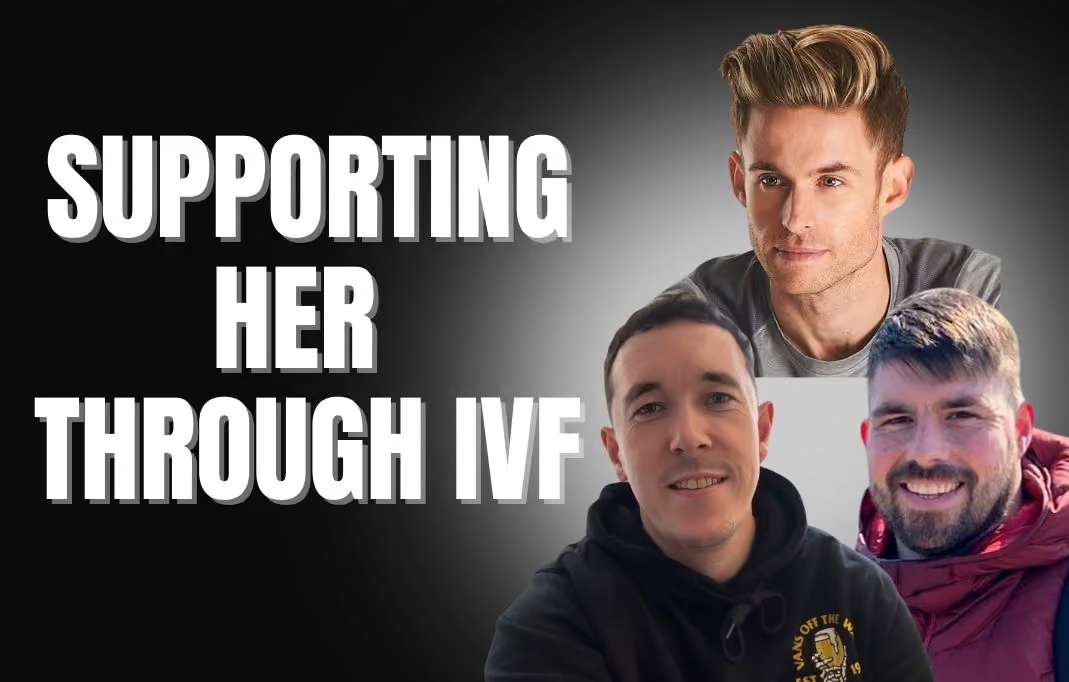
The most useful way to support a partner through IVF is to share responsibility without taking away their control. Learn the treatment plan, attend appointments when invited, take on agreed practical tasks, listen without trying to fix every feeling and check what support they want today. You are part of the treatment too, and looking after your own mental health helps you remain present rather than silently reaching breaking point.
What does good support during IVF look like?
Support is not a fixed list of jobs. It is a continuing conversation about what would help and what your partner wants to manage themselves.
Good support often means:
- Understanding the broad stages of the cycle
- Sharing the mental and practical load
- Respecting that the patient has final say over their body
- Listening without immediately offering solutions
- Making room for both partners’ emotions
- Protecting the relationship from becoming only a treatment project
- Asking for professional help when either person is struggling
Do not assume that being “strong” means hiding every feeling. A partner may want reassurance and honesty, not a performance of certainty.
What should men know about the IVF process?
A typical IVF cycle may include ovarian stimulation with medication, monitoring scans and blood tests, egg collection, fertilisation in the laboratory, embryo development, embryo transfer and a wait before the pregnancy test. The exact plan varies, and cycles may be changed, paused or cancelled for clinical reasons.
Your own role may involve a semen sample, tests, consent forms, decisions about IVF or ICSI and discussions about the use or storage of eggs, sperm and embryos. If surgical sperm retrieval or donor sperm is being considered, the pathway will differ.
Ask the clinic to explain the plan to both of you, with your partner’s consent. Use the clinic’s instructions rather than social-media schedules or someone else’s protocol.
For a fuller treatment overview, read IVF Explained: Everything Men Need to Know.
How can you help with IVF injections and medication?
Start by asking what your partner wants. They may want you to administer injections, prepare equipment, read instructions, set reminders or simply sit with them. They may also prefer to do the injections themselves.
If you are helping:
- Attend or watch the clinic’s medication teaching together.
- Keep the written schedule somewhere you can both access.
- Check the medication, dose and timing against the clinic instructions.
- Store medicines exactly as advised.
- Prepare a clean, calm space and allow enough time.
- Record the dose once it has been taken.
- Contact the clinic if a dose is missed, taken incorrectly or causes concern.
Do not guess, double a dose or rely on this article for injection technique. Know the clinic’s normal-hours and out-of-hours contact routes before treatment begins.
Medication can have physical and emotional effects, but do not dismiss every feeling as “the hormones”. Ask what your partner is experiencing and take symptoms seriously. Use the clinic’s urgent advice if they develop severe pain, marked swelling, vomiting, faintness, breathing difficulty, reduced urination or any symptom the clinic has told you to report.
How can you share the practical load?
IVF creates invisible work: remembering appointments, ordering medication, dealing with employers, checking finance, reading consent forms and fielding questions from family. Waiting to be assigned each task can leave one person carrying the planning as well as the treatment.
Agree ownership of specific jobs, for example:
- Updating a shared calendar
- Arranging travel, parking or childcare
- Preparing questions before appointments
- Taking notes during consultations
- Managing medication deliveries or invoices
- Cooking or organising food on demanding days
- Communicating agreed updates to family
- Checking what work leave each of you can take
Sharing responsibility does not mean taking control. Confirm decisions together and remember that consent belongs to the person whose eggs, sperm or embryos are involved.
What should you say when your partner is upset?
You do not need the perfect sentence. Try:
- “Do you want me to listen, help solve something or just stay with you?”
- “I can see how hard this is. I am here.”
- “What would make today slightly easier?”
- “I do not know what will happen, but we will face the next step together.”
Avoid forced optimism, comparisons and blame. Statements such as “relax”, “at least we can try again” or “everything happens for a reason” can make grief feel dismissed.
It is also reasonable to say, “I am struggling too, and I want us both to have support.” Honesty is different from asking your partner to carry all of your distress while they are undergoing treatment.
How do you communicate when you cope differently?
One person may want constant information while the other needs limits. One may talk immediately after an appointment while the other needs time to process. Neither style is automatically wrong.
Create a simple system:
- Hold a short daily or twice-weekly check-in
- Ask, “How full is your capacity today?”
- Agree which decisions need a joint conversation
- Decide who can be told what
- Put difficult topics aside temporarily, with a time to return to them
- Set boundaries around late-night searching
If every conversation turns into conflict or withdrawal, a fertility counsellor can offer a neutral space before the relationship reaches crisis.
How can you stay connected as a couple?
Treatment can make bodies, sex and calendars feel clinical. Protect small parts of the relationship that do not depend on a cycle result.
You could:
- Plan low-pressure time together between appointments
- Agree some fertility-free conversations or evenings
- Show affection without assuming it must lead to sex
- Mark difficult milestones in a way that feels right to both of you
- Keep ordinary rituals, such as a walk, meal or shared programme
- Ask before initiating sex if procedures or medication have affected comfort
Sex may become pressured when it is linked to conception or sample production. If erections, ejaculation, pain or anxiety become a problem, tell the clinic. These are health concerns, not personal failures.
What can you do during the wait after embryo transfer?
The wait before a pregnancy test can be emotionally intense. You cannot read the outcome reliably from symptoms, and repeated searching may increase anxiety.
Ask your partner what would help: distraction, quiet company, practical planning or limited conversation about the result. Follow the clinic’s instructions on testing date and medication. Do not encourage testing early if the clinic has advised against it.
Make two modest plans for test day: how you will receive the result and who, if anyone, you will contact. Avoid planning every future decision before you have the information.
How should you handle an unsuccessful cycle or cancellation?
An unsuccessful or cancelled cycle can be a real loss even when no pregnancy occurred. People may grieve the embryo, the anticipated child, the effort invested or the future they imagined.
In the first hours or days:
- Do not rush into deciding the next treatment
- Avoid blame or analysing everything you each did
- Cancel optional commitments if you need space
- Ask the clinic when and how a review will happen
- Write questions down as they arise
- Accept that you may grieve differently
A treatment review should explain what happened, what is known and uncertain, whether any change is recommended and the evidence, risks and cost behind it. Be cautious about buying an add-on simply because doing something feels easier than tolerating uncertainty.
How do you look after yourself while supporting a partner?
Partners can feel helpless, guilty or excluded, especially when their own fertility problem contributed to treatment. Your needs matter, but your partner does not have to be your only support.
Consider:
- Speaking to one trusted friend or relative within agreed privacy boundaries
- Using a moderated men’s peer group
- Booking individual or couple fertility counselling
- Maintaining sleep, meals, movement and ordinary contact where possible
- Limiting alcohol or other ways of numbing distress
- Telling your GP if anxiety, low mood or sleep problems persist
Read Male Infertility and Mental Health and Fertility Counselling or Coaching for Men for support options.
If you or someone else is in immediate danger, call 999 or go to A&E. In England, urgent mental-health help that is not an emergency is available through NHS 111 online or by calling 111 and selecting the mental-health option. Samaritans can be called free on 116 123 at any time.
Questions to ask before an IVF cycle
- What are the stages and likely dates in this protocol?
- Which symptoms require an urgent call, and which number should we use?
- What should we do if a medication dose is late, missed or incorrect?
- What is my role in appointments, consent and providing a sample?
- When could the plan change or the cycle be cancelled?
- What counselling or partner support does the clinic offer?
- How and when will results be communicated?
- If the cycle is unsuccessful, when will the review take place?
What do the men in the original panel share?
The original session brings together men who have lived through injections, appointments, uncertainty and the emotional weight of IVF. Its strongest contribution is not a single formula for support, but the recognition that practical involvement, honest communication and connection matter.
Before publication, add the approved names and roles of all panel contributors. Check every summary and quotation against the recording and obtain permission for any sensitive personal detail. Do not create reconstructed quotations to make the page appear more complete.
The most important thing to remember
Supporting a partner through IVF is not about taking over or never struggling yourself. Ask what help is wanted, learn the treatment plan, own agreed practical tasks, listen without minimising and find support outside the relationship when you need it. You are a team, but each person still has a body, emotions and choices that deserve respect.
Join The Male Fertility Hub community to connect with people who understand fertility treatment.
Related articles
- IVF and ICSI Explained with Consultant Embryologist Lyndon Miles
- IVF Add Ons Explained with Professor Tim Child, Evidence You Can Trust
- NHS Fertility Funding for Men Explained with Anne Howard
Sources
- HFEA: In vitro fertilisation (IVF)
https://www.hfea.gov.uk/treatments/explore-all-treatments/in-vitro-fertilisation-ivf/ - HFEA Code of Practice: Counselling and patient support
https://portal.hfea.gov.uk/knowledge-base/read-the-code-of-practice/ - NHS: IVF
https://www.nhs.uk/tests-and-treatments/ivf/ - NHS: Urgent support for mental health
https://www.nhs.uk/every-mind-matters/urgent-support/ - British Infertility Counselling Association
https://www.bica.net/
This article provides general information and does not replace the instructions of your fertility clinic or individual medical advice.