
Download this resouce by completing the form below
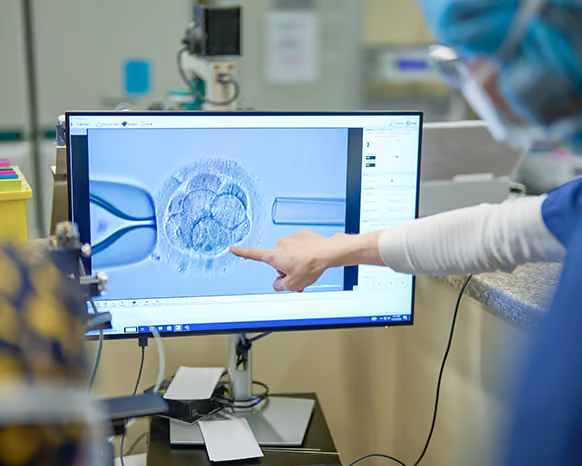
Fertilisation happens when a sperm fuses with an egg and their genetic material combines. The resulting embryo divides as it travels towards the uterus, usually reaching the blastocyst stage after about five or six days. Implantation begins when the blastocyst attaches to and enters the uterine lining. In IVF, fertilisation and early development happen in the laboratory before an embryo is placed in the uterus.
What is fertilisation?
Fertilisation is the process in which one sperm penetrates an egg and the genetic material from both combines. In unassisted conception, it usually happens in a fallopian tube after ovulation. The fertilised egg is called a zygote at the single-cell stage.
Fertilisation is necessary, but it is not the same as an ongoing pregnancy. The embryo still has to divide, develop, reach the uterus, implant and continue developing. Many steps cannot be felt or observed outside a laboratory.
How does sperm reach and fertilise an egg?
After ejaculation, sperm must travel through the cervix and uterus towards a fallopian tube. Only a small proportion reach the area where an egg may be present. Sperm undergo biological changes that allow one to interact with and enter the egg.
Once one sperm has fused with the egg, changes in the egg normally prevent additional sperm from entering. The maternal and paternal chromosomes then come together as the first cell prepares to divide.
Sperm count matters, but fertilisation also depends on motility, function, timing, the egg, the fallopian tube and other factors. A semen analysis estimates parts of male fertility; it cannot show whether a particular sperm will fertilise an egg naturally.
What happens after fertilisation?
Embryo development is continuous, and not every embryo follows the same clock. A simplified timeline is:
Day 0 to 1
- Developmental stage: Zygote
- What is happening: The egg and sperm genetic material combine and the single cell prepares to divide
Day 2
- Developmental stage: Early cleavage
- What is happening: The embryo has divided into a small number of cells
Day 3
- Developmental stage: Cleavage-stage embryo
- What is happening: Further cell division continues, often with several cells visible in an IVF laboratory
Day 4
- Developmental stage: Morula
- What is happening: Cells compact into a more solid-looking cluster
Day 5 to 6
- Developmental stage: Blastocyst
- What is happening: A fluid-filled cavity forms and cell groups that contribute to the fetus and placenta become distinguishable
Around day 6 onwards
- Developmental stage: Hatching and implantation
- What is happening: The blastocyst leaves its outer shell and begins interacting with the uterine lining
These are approximate stages, not deadlines. In IVF, embryos may reach the blastocyst stage on day 5, 6 or occasionally later. Development speed and appearance give the embryology team useful information but cannot guarantee implantation or a healthy birth.
What is a blastocyst?
A blastocyst is an embryo that has developed for roughly five or six days and contains many cells arranged around a fluid-filled cavity. It includes:
- An inner cell mass, which contributes to the fetus
- Trophectoderm cells, which contribute to the placenta and supporting tissues
- A surrounding outer layer, or zona pellucida, from which the blastocyst must hatch
In IVF, an embryo may be transferred at the cleavage stage on day 2 or 3, or at the blastocyst stage around day 5. The HFEA reports that both stages are used in UK treatment. Not every fertilised egg becomes a transferable blastocyst, which is one reason the number of embryos can fall between egg collection and transfer.
What is implantation?
Implantation is a sequence in which a blastocyst first makes contact with the endometrium, attaches and then begins embedding within the lining. The embryo and uterine lining communicate through hormones, signalling molecules and changes in the tissue.
After implantation begins, cells that will help form the placenta produce human chorionic gonadotrophin, or hCG. Pregnancy tests detect hCG in urine or blood. It is inaccurate to say the uterus simply “releases hCG” at implantation.
Implantation is not a moment that can usually be identified from a sensation. Clinical pregnancy is confirmed later with testing and, where appropriate, ultrasound.
How is fertilisation different in IVF or ICSI?
In conventional IVF, eggs and prepared sperm are placed together in the laboratory and fertilisation is checked the following day. In ICSI, an embryologist injects one selected sperm into each mature egg. ICSI helps the sperm enter the egg, but it does not guarantee normal fertilisation, embryo development, implantation or birth.
Embryos are monitored in the laboratory for several days. Depending on the treatment plan, one may be transferred in a fresh cycle or suitable embryos may be frozen for later use. During transfer, the clinician places the embryo through the cervix into the uterine cavity using a thin catheter.
The embryo cannot fall out when the patient stands or goes to the toilet. Prolonged bed rest after transfer has not been shown to improve pregnancy rates.
Read IVF and ICSI Explained for the differences between the procedures.
When does implantation happen after embryo transfer?
Timing depends on the embryo’s developmental stage. A day-5 blastocyst is further along than a day-3 cleavage embryo, so the interval between transfer and possible implantation differs.
Clinics calculate the pregnancy-test date from the treatment protocol, egg collection and transfer. Follow the date your clinic gives you rather than using a generic online calendar.
Testing too early can mislead. An hCG trigger injection may remain in the body for several days and cause an early false-positive result, while testing before enough hCG is present can produce a false negative. Continue medication and test on the instructed date even if bleeding occurs, unless the clinic tells you otherwise.
Are there reliable implantation symptoms?
No symptom can confirm whether an embryo has implanted. Some people notice light spotting, mild cramping, breast tenderness or tiredness; many notice nothing. After IVF, progesterone and other medication can cause symptoms that resemble early pregnancy, and the transfer procedure itself may contribute to light bleeding.
Symptoms are therefore not a useful way to predict the result. Equally, having no symptoms does not mean the transfer failed.
Contact the clinic for advice about symptoms rather than trying to classify them as “implantation”. Follow urgent guidance for heavy bleeding, severe or one-sided abdominal pain, shoulder-tip pain, faintness, breathing difficulty, fever, marked swelling, vomiting, reduced urination or feeling very unwell. IVF pregnancies can still be ectopic, so bleeding or pain after a positive test needs prompt assessment.
Can anything you do after embryo transfer make implantation happen?
There is no proven action that makes an embryo implant after transfer. Follow the clinic’s instructions, take prescribed medication and live normally within any restrictions given for your individual treatment.
In particular:
- Normal walking and going to the toilet do not dislodge an embryo
- Prolonged bed rest does not improve success
- Stressful thoughts do not cause an embryo to fall out
- A particular food cannot guarantee implantation
- Do not begin supplements or medication without checking with the clinic
Partners can help by sharing practical work, reducing pressure to interpret every symptom and following the agreed testing plan.
Why might fertilisation not happen in IVF?
Possible reasons include egg maturity or quality, sperm factors, problems with egg-sperm interaction or events that cannot be identified from routine observations. Sometimes no clear explanation is available.
If fertilisation is unexpectedly low or absent, ask the embryologist:
- How many eggs were collected and how many were mature?
- How many were inseminated or injected?
- How many showed normal fertilisation?
- Were there observations about egg or sperm quality?
- Would ICSI be appropriate in a future cycle, and why?
- What uncertainty remains?
A single outcome should be interpreted in the context of the full cycle and both partners, not assigned automatically to the man or woman.
Why might an embryo not implant?
An embryo may not implant for many possible reasons, and an individual failed transfer often has no identifiable single cause. Embryo chromosomal factors are important, as are age-related egg factors. The uterine cavity, endometrium, timing and other clinical issues may be relevant in selected cases.
However, broad lists of possible causes can encourage unnecessary tests. A negative pregnancy test does not prove an immune problem, infection, blood-clotting disorder, “toxic” lifestyle or failure to rest.
After one or more unsuccessful transfers, the clinic should review:
- Embryo number, stage and laboratory observations
- The transfer procedure
- Uterine and endometrial information already available
- Medication and protocol
- Pregnancy and treatment history
- Whether any targeted investigation would change care
Ask for the evidence before paying for an add-on. The HFEA rates fertility treatment add-ons because many tests and treatments are offered without good evidence that they increase the chance of a baby for most patients.
What does “recurrent implantation failure” mean?
There is no single universally accepted number of failed transfers that diagnoses recurrent implantation failure for every patient. The European Society of Human Reproduction and Embryology recommends an individualised assessment that considers factors such as age, embryo stage and the estimated chance that implantation should have occurred.
Avoid using the label after one unsuccessful transfer. It may create the impression that implantation itself has been directly observed or that a special cause must exist. Many proposed tests and treatments are not recommended because evidence of benefit or safety is insufficient.
How can a male partner help during this stage?
- Learn the clinic’s timeline and contact routes
- Take shared responsibility for medication reminders and appointments, if wanted
- Avoid asking for symptom updates throughout the day
- Agree when and how you will test
- Protect some fertility-free time
- Listen without insisting on optimism
- Seek your own support rather than hiding distress
- Know the urgent symptoms the clinic has asked you both to watch for
Read How to Support Your Partner Through IVF for a fuller practical guide.
Questions to ask the embryology or clinical team
- How many eggs fertilised normally?
- What stage did each embryo reach?
- Why are you recommending a day-3 or blastocyst transfer in our case?
- What can embryo grading tell us, and what can it not tell us?
- Which embryo was transferred and which were suitable for freezing?
- On what date should we test, and why?
- Which medication should continue after transfer?
- Which symptoms require an urgent call?
- If the test is negative, when will the cycle review take place?
- How would any proposed additional test change the treatment plan?
The most important thing to remember
Fertilisation is the beginning of a sequence, not a guarantee of pregnancy. Embryos divide, may reach the blastocyst stage and then need to implant and continue developing. After transfer, symptoms cannot reliably reveal the outcome and ordinary movement does not make an embryo fall out. Follow the clinic’s medication and testing instructions, and ask for evidence before adding tests or treatments after an unsuccessful cycle.
Join The Male Fertility Hub community if treatment and waiting feel isolating.
Related articles
- IVF Explained: Everything Men Need to Know
- IVF Add Ons Explained with Professor Tim Child, Evidence You Can Trust
- NHS Fertility Funding for Men Explained with Anne Howard
Sources
- HFEA: Decisions to make about your embryos
https://www.hfea.gov.uk/treatments/explore-all-treatments/decisions-to-make-about-your-embryos/ - HFEA: In vitro fertilisation
https://www.hfea.gov.uk/treatments/explore-all-treatments/in-vitro-fertilisation-ivf/ - HFEA: Treatment add-ons
https://www.hfea.gov.uk/treatments/treatment-add-ons/ - NHS: IVF
https://www.nhs.uk/tests-and-treatments/ivf/ - Cambridge University Hospitals: Patient information after embryo transfer
https://www.cuh.nhs.uk/patient-information/patient-information-after-embryo-transfer/ - ESHRE: Good practice recommendations on recurrent implantation failure
https://www.eshre.eu/Guidelines-and-Legal/Guidelines/RIF
This article provides general information and does not replace your clinic’s instructions or individual medical advice. Seek urgent help for concerning symptoms.