Download this resouce by completing the form below
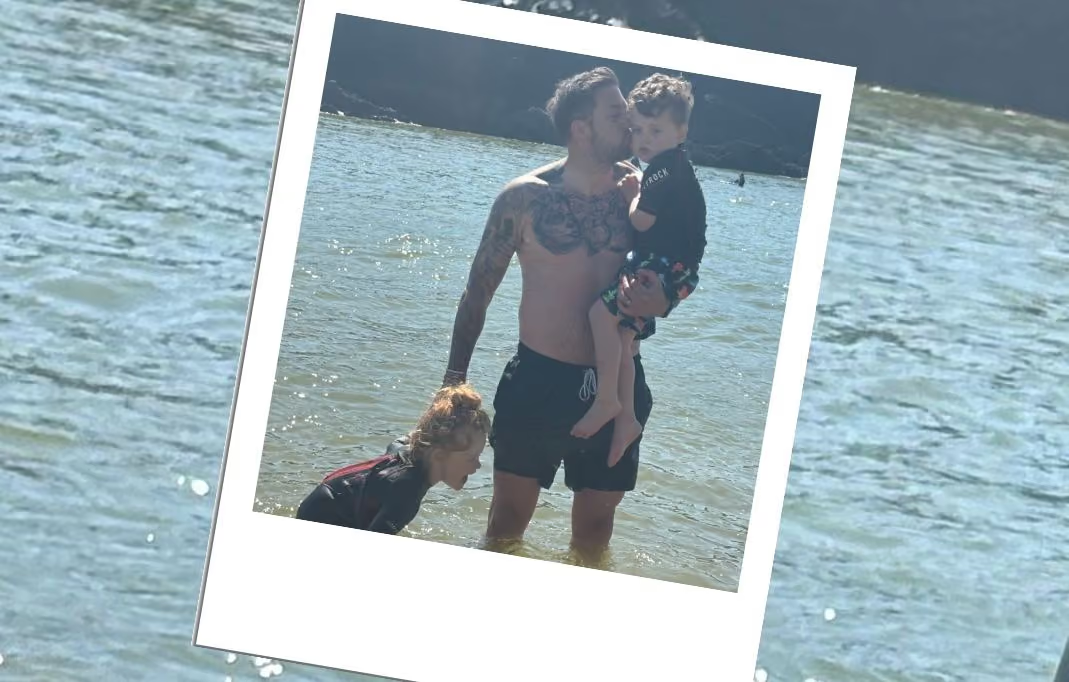
You can be a secure, loving father without a genetic link to your child. That does not make the loss of the expected genetic connection easy or irrelevant. In Shaun Greenaway’s experience, grief and uncertainty took time, while fatherhood became real through presence, care and the relationship built with his children. His story is one family’s experience, not a promise about how every man will feel.
Can you be a “real dad” without sharing your child’s DNA?
Yes. Genetics can matter to people, but it is not a test of who parents a child. Fatherhood is lived through responsibility, attachment, care, values and thousands of ordinary moments.
For a man facing male infertility, that answer may be intellectually clear long before it feels emotionally true. A diagnosis can unsettle assumptions about family, identity and what you expected to pass on. Saying that biology does not define fatherhood should not be used to rush someone past that loss.
Shaun’s story matters because it holds both ideas together: grief was real, and a full relationship with his children is real too.
How did infertility affect Shaun’s sense of identity?
Shaun describes acceptance as a long process. Before he had language for infertility grief, the feelings could appear as anger or resentment:
“You don’t know why you’re angry, you don’t know why you’re resentful. But looking back, it’s all completely normal.”
This does not mean every man will respond with anger or that any behaviour becomes acceptable. It means an emotion may have a loss beneath it. Naming the loss can make it easier to talk rather than withdraw, blame or pretend nothing is happening.
If the diagnosis has left you feeling ashamed or less masculine, remember that fertility is a health issue. A sperm result does not measure character, sexual ability or capacity to parent.
What helped Shaun rethink fatherhood?
A turning point came when Shaun asked his wife what she loved about him. The qualities she described were about who he was, not his genes: character, resilience, humour and love.
That conversation changed the question. Instead of asking only, “What genetic traits will I pass on?”, he could also ask, “What kind of father will I be, and what will my children experience from me?”
This reframing is not a demand to stop caring about genetics. It broadens inheritance beyond DNA. Children absorb language, rituals, humour, values, interests, stories and ways of relating from the people who raise them.
Try asking yourself:
- Which qualities do I hope to bring to parenting?
- What did I value in the people who cared for me?
- What traditions or stories would I like to share?
- What does showing up for a child look like in ordinary life?
Did Shaun worry that he would not bond with his children?
Yes. The possibility that the relationship might feel different was one of his fears before parenthood. In the original article, he reflects:
“Love takes work. And it’s no different with children born via donor conception. The connection is just as strong between us.”
The important point is not that every fear will disappear instantly at birth. Bonding can be immediate or gradual in any family. Anxiety, depression, sleep deprivation and difficult pregnancy or birth experiences can affect parents regardless of conception route.
Connection grows through care: learning a baby’s cues, soothing them, playing, repairing after hard moments and remaining emotionally available. If you feel detached or unable to function after a child is born, speak to your GP or health visitor rather than interpreting it as proof that donor conception failed.
How did Shaun and his wife choose a donor?
They used their clinic’s in-house donor programme. For them, this reduced the number of decisions during an already overwhelming period. They focused on health information and broad characteristics rather than trying to reproduce Shaun exactly.
No donor can be a genetic copy of an intended parent, and a list of traits cannot predict a future child’s personality. When considering a donor, also think beyond the immediate match:
- What medical and family history is available?
- What personal description or goodwill message has the donor provided?
- Which identity-release rules apply?
- Could the donor have been used in other countries?
- What information might matter to your future child?
- Can sperm be reserved for a sibling?
Choosing fewer characteristics is not inherently better, and reviewing more information is not inherently shallow. The useful question is whether the process respects the future child as a person rather than treating donor selection as designing a baby.
For UK treatment, legal and identity information, read Donor Sperm Conception for Men: UK Process, Law and Parenthood.
How long did acceptance take?
Shaun says it took around a year and a half before he felt genuinely comfortable with donor conception. He also makes clear that acceptance did not mean grief vanished forever.
That timescale belongs to him. It is not a recommended waiting period or a deadline. Some men move faster, some need longer and some decide donor conception is not right for them.
Readiness may look less like complete certainty and more like being able to:
- Discuss the route without blaming yourself, your partner or the child
- Accept that the child may be curious about the donor
- Plan openness rather than secrecy
- Complete counselling and consent thoughtfully
- Tolerate some unanswered questions
- Choose the route rather than feeling pushed into it
If treatment timing creates pressure, ask the clinic which decisions are genuinely time-sensitive and which can wait.
What about comments on family resemblance?
People often look for resemblance in new babies and may make casual comments without knowing the family’s story. Shaun’s response changed over time. At first, fuller disclosure sometimes formed part of his own processing; later, he was more comfortable giving a light answer or no explanation.
You do not owe acquaintances your child’s private information. Agree with your partner how you will handle different settings. Possible replies include:
- “Families find resemblance in lots of ways.”
- “They definitely have the family sense of humour.”
- “We keep the details of their conception private for them.”
- “That is their story to share when they are older.”
Relatives who know about the donor conception should not turn resemblance into a test of belonging or discuss the child’s origins without permission.
How did Shaun begin talking to his children?
Shaun and his wife chose openness from the beginning. They started telling the story while their children were babies, partly so the language became natural for the parents before the children could understand it.
One version became a family fairy tale beginning with Prince Daddy and Princess Mummy and explaining that Daddy did not have the seeds needed to make a baby. The exact metaphor will not suit every family or every age, but the principle is useful: begin simply, speak without shame and add accuracy as the child grows.
Early telling is not a single completed task. A child’s questions will change. Parents can:
- Use the correct idea of a sperm donor alongside age-appropriate metaphors
- Make clear that the donor helped create the child but is not the parenting father
- Share available non-identifying information gradually
- Explain that identifying information may be available when the child is older
- Welcome interest in the donor or genetic siblings
- Admit when an answer is unknown
- Let the child’s feelings be different from the parents’ feelings
The HFEA recommends openness from early childhood. Consumer DNA matching also makes planned, honest family communication increasingly important.
Can grief return after becoming a parent?
Yes. A positive treatment outcome does not erase infertility. Grief may reappear around pregnancy, birth, comments about resemblance, a child’s questions or applications for donor information.
Returning feelings do not mean you regret or love your child less. They may mean an old loss has met a new milestone. A specialist counsellor, donor-recipient parent group or trusted peer can give you somewhere to talk without making the child responsible for reassuring you.
What can men considering donor conception take from Shaun’s story?
- Give grief a name rather than expecting action to remove it
- Ask what fatherhood means beyond genetics
- Talk honestly with your partner, including about different timelines
- Choose a donor with the future child’s needs in mind
- Expect bonding to be a relationship, not a genetics test
- Begin the child’s story early and keep it open
- Prepare boundaries for questions from other people
- Use support after treatment as well as before it
These are reflections, not a treatment protocol. Another man may make a different decision after equally thoughtful consideration.
Questions to explore before moving forward
- What am I most afraid donor conception will change?
- What part of the genetic loss still needs attention?
- Can my partner and I talk without one person persuading the other?
- How do we want to describe the donor’s role?
- How will we start telling our child?
- What information and legal consents must we check with the clinic?
- Who can support me if grief returns after we become parents?
About the original podcast episode
This article is based on Shaun Greenaway’s personal account on The Male Fertility Podcast. Listen to the episode for his voice and full context. Before publication, Shaun should approve the edited narrative, both quotations, the description of his children and the family story.
Remove the old promotion for the 12 June live event from the live article. It is no longer a useful call to action and dates the page unnecessarily. Replace it with evergreen links to the donor-conception guide, current events listing and community.
Read Donor Conception Stories from Three Dads for more lived perspectives, or join The Male Fertility Hub community.
The most important thing to remember
The loss of a genetic connection can be painful, and it does not disqualify you from becoming a deeply connected father. Shaun’s acceptance grew through time, reflection, openness and the daily reality of parenting. You do not have to copy his path, but you deserve enough support to choose your own without secrecy or shame.
Sources and further information
- HFEA: Talk to your child about their origins
https://www.hfea.gov.uk/donation/finding-out-about-your-donor/talk-to-your-child-about-their-origins/ - HFEA: Using donated eggs, sperm or embryos in treatment
https://www.hfea.gov.uk/treatments/explore-all-treatments/using-donated-eggs-sperm-or-embryos-in-treatment/ - Donor Conception Network
https://dcnetwork.org/ - The Male Fertility Podcast
https://open.spotify.com/show/52eex3fLgBRaeebjbtqd8a
This article shares one person’s lived experience and general information. It does not predict another family’s experience or replace medical, counselling or legal advice.