
Download this resouce by completing the form below
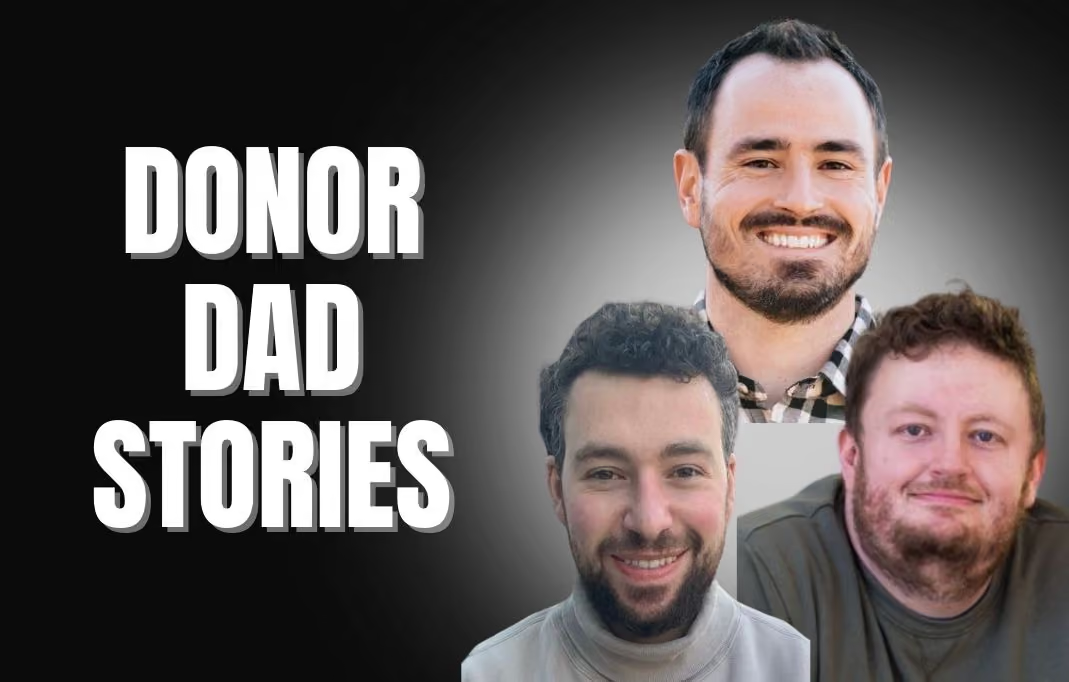
Men considering donor sperm often worry about grief, identity, bonding and whether they will feel like a “real” dad. In this lived-experience session, Alex, David and Marc discuss moving from a male-infertility diagnosis to raising their families. Their routes and feelings are individual, but the shared message is that uncertainty can be explored honestly and that fatherhood is formed through an enduring relationship, not reduced to a genetic connection.
What can real dads tell you that a clinical guide cannot?
A clinic can explain treatment, screening, consent and success rates. It cannot tell you exactly how a diagnosis will feel on the drive home, how a couple reaches a decision at different speeds or what ordinary parenting feels like years later.
Lived experience can help you:
- Recognise feelings that are difficult to name
- Hear that uncertainty before treatment is common
- Prepare questions for your partner, counsellor and clinic
- Imagine life beyond the next appointment
- See that there is more than one healthy way to build a family
It cannot predict your future. Alex, David and Marc are not evidence that every man will feel the same, and their choices are not instructions. Use their stories as company and perspective, not a test of whether you are “ready enough”.
How do men process a diagnosis that changes the route to parenthood?
Learning that you cannot use your own sperm, or that the chance is extremely low, can create several losses at once: the expected route to conception, a genetic connection and a picture of the child you imagined.
Some men need to understand every medical detail. Others initially avoid the subject or focus on supporting their partner. Relief can appear alongside grief when a donor route offers a way forward. None of these reactions automatically tells you what decision to make.
Give the diagnosis enough space before treating donor sperm as the next item on a protocol. Useful questions include:
- Have the test results and possible causes been explained clearly?
- Are any further investigations or reasonable alternatives available?
- What exactly am I grieving?
- Do I feel able to speak about donor conception without shame?
- Am I making this decision freely or because treatment feels urgent?
If you and your partner move at different speeds, agree what information you need and when you will revisit the decision. Time to process is not rejection of your partner or of a future child.
What fears do men have before choosing donor sperm?
Common fears include:
- “Will I bond with the child?”
- “Will the child see me as their dad?”
- “What if they look nothing like me?”
- “Will they want the donor instead of me?”
- “What will our families say?”
- “How and when will we tell the child?”
- “Will I always feel that infertility took something from me?”
Trying to eliminate every fear before treatment is unrealistic. A more useful goal is to understand which concerns require information, which need emotional work and which may remain uncertain.
Specialist implications counselling can help you discuss genetic connection, legal parenthood, donor identity, genetic siblings, openness and the future child’s perspective. It should not be a box-ticking exercise or an attempt to persuade you.
Does using donor sperm make you less of a father?
No. In treatment through a licensed UK clinic, the sperm donor is not the child’s legal parent. Legal parenthood for the intended partner depends on marital or civil-partnership status and, in some circumstances, correctly completed consent forms before treatment.
But the question is usually emotional rather than only legal. Fatherhood develops through care: night feeds, comfort, boundaries, school runs, jokes, repair after conflict and showing up repeatedly. Genetics may be meaningful to a child, but it does not measure the quality or authenticity of the parent-child relationship.
Avoid asking a child to prove your place by showing no interest in the donor. Curiosity about genetic origins can coexist with love and security in the family that raises them.
For the current UK rules, read Donor Sperm Conception for Men: UK Process, Law and Parenthood.
What is bonding like in a donor-conceived family?
Bonding is not always an instant feeling at a positive pregnancy test or birth. Some fathers feel connected early; others grow into the relationship through everyday care. This also happens in families conceived without a donor.
If bonding is slower than you expected, do not treat that as proof that donor conception was a mistake. Sleep deprivation, anxiety, birth complications, depression and the adjustment to parenthood can affect any parent. Speak to your GP or health visitor if low mood, withdrawal or difficulty functioning persists.
Practical ways to create connection include:
- Being involved in pregnancy and birth planning where welcomed
- Sharing routine care from the beginning
- Having regular one-to-one time with the baby or child
- Learning the child’s cues rather than looking for a dramatic feeling
- Talking honestly with a counsellor if grief returns
You do not need to erase the donor to strengthen your bond.
How do parents talk to a child about donor conception?
The HFEA advises talking about donor conception from early childhood. Openness is usually an unfolding story, not a single disclosure.
Start with simple, accurate language and add detail as the child grows. Let them ask the same question more than once. If you feel tense or ashamed, explore that feeling with a counsellor so the child does not learn that their origins are dangerous to mention.
Helpful principles include:
- Make the story part of ordinary family life
- Use age-appropriate books and resources
- Do not ask the child to keep the information secret
- Say what is known and unknown about the donor
- Prepare for interest in genetic siblings or identifying information
- Accept feelings that differ from your own
- Keep the conversation open across childhood and adulthood
People conceived from donations made on or after 1 April 2005 can generally apply to the HFEA for identifying donor information at 18. Non-identifying information is available earlier. Consumer DNA matching also means families should not assume genetic origins will remain hidden.
What should you tell relatives and friends?
The child’s conception story belongs first to the child and immediate family. Agree with your partner who needs to know, what can be shared and what must remain private.
Before telling someone, consider whether they will:
- Respect that donor conception is not shameful
- Keep sensitive details private
- Use accurate language
- Treat every child in the family equally
- Avoid making the donor the centre of the child’s identity
- Support the child’s right to ask questions later
If a relative reacts poorly, you do not have to debate immediately. Set a boundary, provide a reliable resource and return to the conversation only if it is safe and useful.
What might you wish you had known at the start?
Many men begin treatment focused on achieving a pregnancy. Parenthood through donor conception extends far beyond that result. Before proceeding, make room for the long term:
- The donor is not anonymous in modern UK clinic donation
- A child may have genetic siblings in several families
- Overseas donor use can create additional genetic siblings
- Medical and family-history information may evolve
- Children need a story that grows with them
- Curiosity about the donor is not a verdict on the father
- Infertility grief can return at milestones
- Support may still be useful after a baby is born
No parent can answer every future question in advance. Preparation means building openness and knowing where to find help, not controlling how a child will feel.
Questions to discuss before treatment
- Have we each had enough time to consider donor conception?
- What information do we have about the donor and the applicable identity rules?
- How will we make sure legal-parenthood consent is correct?
- When and how will we begin talking with our child?
- What language will we use with relatives?
- How will we respond if our child wants donor or sibling information?
- Can sperm be reserved for a genetically related sibling, and at what cost?
- Where can each of us find support if grief or doubt returns?
About the original session
Recorded to mark International Donor Conception Awareness Day, the original session brings together donor-recipient dads Alex, David and Marc. They discuss diagnosis, identity, relationships, choosing donor sperm, fears before treatment, bonding, family conversations and what they wish they had known.
Before publication, check every statement about an individual against the complete recording. Obtain approval for the contributors’ public names, biographies, family details, images and any quotations. Do not turn a general theme into an attributed personal story unless the contributor actually said it.
Add three short, recording-verified pull quotes only if each contributor approves the final wording and context. Quotes should add lived perspective rather than repeat the article’s factual sections.
The most important thing to remember
You do not need to pretend the loss of a genetic connection is insignificant in order to become a secure and loving father. Process the diagnosis, learn the lifelong implications, listen to donor-conceived perspectives and choose openness. Other dads’ stories can help you imagine the road, but your relationship with your child will be built in the life you share.
Join The Male Fertility Hub community for peer connection with men who understand infertility and alternative routes to parenthood.
Sources and further information
- HFEA: Using donated eggs, sperm or embryos in treatment
https://www.hfea.gov.uk/treatments/explore-all-treatments/using-donated-eggs-sperm-or-embryos-in-treatment/ - HFEA: Talk to your child about their origins
https://www.hfea.gov.uk/donation/finding-out-about-your-donor/talk-to-your-child-about-their-origins/ - HFEA: Becoming the legal parents of your child
https://www.hfea.gov.uk/treatments/explore-all-treatments/becoming-the-legal-parents-of-your-child/ - Donor Conception Network
https://dcnetwork.org/
This article combines general information with a summary of lived experience. It does not provide medical or legal advice, and one family’s experience cannot predict another’s.