
Download this resouce by completing the form below
Donor sperm can offer a route to parenthood when a man cannot use his own sperm or when using it would carry a serious genetic risk. In the UK, treatment through an HFEA-licensed clinic provides screening, consent and legal safeguards. The decision also has lifelong emotional and identity implications. Take time to process genetic loss, understand what a future child may learn about the donor and plan open, age-appropriate conversations from early childhood.
When might a couple consider donor sperm?
Donor sperm may be discussed when:
- No usable sperm are found in the ejaculate or through surgical retrieval
- Sperm quality makes treatment with a man’s own sperm very unlikely to work
- Previous IVF or ICSI cycles have repeatedly failed and donor sperm is one option
- There is a serious inherited condition that the couple does not want to pass on
- Medical treatment has permanently affected sperm production
- A couple decides not to pursue further procedures using the man’s sperm
It is an option, not an obligation. Ask what has been investigated, whether results have been confirmed, what alternatives exist and what the realistic benefits, burdens and costs are. A second clinical opinion may be useful before an irreversible decision.
Is it normal to grieve the loss of a genetic connection?
Yes. Wanting to become a parent and grieving the loss of a genetic connection can exist at the same time. You might feel sadness, anger, relief, jealousy, shame or uncertainty. You may worry about bonding, resemblance, what family members will say or whether you will feel like the “real” father.
Do not force yourself to feel grateful or ready on someone else’s timetable. Moving forward is easier when donor conception is an active, considered choice rather than a treatment step taken under pressure.
Questions worth exploring include:
- What did having a genetic connection mean to me?
- Am I choosing donor conception, or only trying to stop the pain of infertility?
- How would I feel talking openly with our child?
- Can my partner and I tolerate different feelings and different speeds?
- Who in our family needs to know, and who gets to decide?
- How will we respond to difficult or insensitive comments?
A specialist fertility counsellor can help without directing the decision. Licensed clinics must offer counselling, and donor conception deserves more than a brief administrative conversation.
Will you bond with a child conceived using donor sperm?
Genetic connection and parenthood are not the same thing. Parenting is built through care, attachment, daily life, responsibility and a relationship that develops over time. Donor conception does not make the intended father less of a parent.
At the same time, reassurance should not erase uncertainty. Some fathers bond during pregnancy, some after birth and some more gradually. That variation also exists in families without donor conception.
It helps to avoid treating the donor as a rival or pretending genetics are irrelevant. Your child may be curious about the donor or genetic relatives while loving you fully as their parent. Curiosity is not rejection.
How does donor sperm treatment work in the UK?
The exact treatment depends on the patient’s health and fertility assessment. Donor sperm may be used in intrauterine insemination, IVF or, in selected circumstances, another treatment plan. The clinic should explain why it recommends a particular route.
Through an HFEA-licensed clinic, the process generally includes:
- Assessment of both intended parents and discussion of treatment options
- Information about the donor-conception implications
- An offer of specialist counselling
- Selection or allocation of a donor through a clinic or sperm bank
- Donor screening and the clinic’s suitability checks
- Written consent, including legal-parenthood forms where required
- Treatment, storage and reporting under HFEA rules
The clinic should explain success rates in a way that applies to the planned treatment and the person providing the eggs. Donor characteristics do not override the major clinical factors affecting treatment outcome.
What information can you receive about a sperm donor?
Clinics may provide non-identifying information such as physical characteristics, medical and family history, interests, a personal description and a goodwill message, depending on what the donor supplied.
Ask to see all information that can lawfully be shared before making a decision. Consider what may matter to your future child, not only which characteristics appear to match your family.
Donor screening reduces known risks but cannot guarantee a child will have no medical or genetic condition. Family and medical information may also change later. Ask the clinic how updated information is handled and how your family could report or receive a significant medical development.
Is sperm donation anonymous in the UK?
Not for new donations through licensed UK clinics. People conceived from donations made on or after 1 April 2005 can generally apply to the HFEA for identifying information about the donor when they turn 18. At 16, a donor-conceived person can request non-identifying information. Parents can request non-identifying information on their child’s behalf and use it in age-appropriate conversations.
The identifying information may include the donor’s name, date of birth and last known address. It does not create a legal obligation for the donor to reply or meet.
Older donations are subject to different rules unless a previously anonymous donor has chosen to become identifiable. Ask the clinic which rules apply to the specific donor.
Home DNA testing and matching services also mean that practical anonymity cannot be promised. A donor or genetic relative may be identifiable outside the HFEA process, potentially before a child turns 18.
How many families can use the same donor?
In licensed UK treatment, one donor’s sperm may be used to create children in up to ten families. There is no UK limit on the number of children within each of those families, and a donor may choose a lower family limit.
The UK limit does not necessarily show the total number of families worldwide. Sperm from an overseas bank may be used in other countries under different limits, and UK-donated sperm exported abroad may also be subject to different rules. Ask:
- Is the donor used outside the UK?
- What family limit applies in each jurisdiction?
- What information does the bank hold about births and genetic siblings?
- Can you reserve sperm for a genetically related sibling in your own family?
Do not promise a precise maximum number of genetic siblings unless the clinic or bank can substantiate it across every place the donor has been used.
What are the legal-parenthood rules?
Legal parenthood depends on the circumstances and must be checked before treatment.
When donor sperm is used at a licensed UK clinic, the donor is not the legal parent and has no parental or financial responsibility for the child. The person who gives birth is the child’s legal mother.
If the birth mother is married or in a civil partnership, their spouse or civil partner will generally be the second legal parent unless they did not consent to treatment. If the intended parents are not married or in a civil partnership, both must complete the appropriate HFEA legal-parenthood consent forms before insemination or embryo transfer for the partner to be recognised as the second legal parent.
Ask the clinic for copies of every completed form. Errors may require court proceedings to establish parenthood later.
Private or unregulated sperm-donation arrangements are legally and medically more complex. The donor may be treated as the legal father, and an informal donor agreement is not guaranteed to determine legal status. Seek specialist independent legal advice before any arrangement outside a licensed clinic.
This section is general information, not legal advice. Rules can depend on marital status, treatment location, timing, surrogacy and individual circumstances.
What should you know about importing donor sperm?
Imported sperm used by a UK clinic must meet applicable UK safety and quality requirements. The rules differ between Great Britain and Northern Ireland. In Great Britain, imports from outside the UK, including EU and EEA countries, generally require the clinic’s relevant import authorisation. Northern Ireland has different territorial rules.
Do not try to manage a clinical import yourself. Ask the treating clinic:
- Whether it can import from the chosen bank
- What screening and documentation have been verified
- Which identity-release rules apply to the donor
- How UK and overseas family limits interact
- What transport, storage and administration charges apply
- What happens if additional vials are needed for a sibling
The fact that sperm is sold by a large commercial bank does not remove the clinic’s responsibility to check compliance.
When should you tell a child they are donor-conceived?
The HFEA advises openness from early childhood. The aim is not one dramatic disclosure but an age-appropriate story that grows with the child. Early conversations can make donor conception an ordinary part of family history and reduce the risk of a shocking discovery later.
You can begin with simple ideas about how families are made and add detail as the child’s understanding develops. Use accurate language, welcome repeated questions and allow feelings that are different from yours.
Avoid framing the donor as a secret, a threat or a topic your child must protect you from. Also avoid deciding in advance that your child will or will not want information or contact. That choice belongs to them as they mature.
The Donor Conception Network offers “Telling and Talking” resources, workshops and peer support. A specialist counsellor can help if you are starting the conversation later in a child’s life.
What questions might a donor-conceived child ask?
Questions change with age and may include:
- Why did you need a donor?
- What do you know about them?
- Do I look like the donor?
- Do I have genetic siblings?
- Can I contact the donor?
- How did you feel when you chose this route?
- Why did you tell me at this age?
You do not need every answer. Say what you know, what you do not know and how you will help the child access information when eligible. Their interest in genetic origins can coexist with a secure relationship with you.
Questions to ask the clinic or sperm bank
- Why is donor sperm being recommended, and what alternatives remain?
- Which treatment is proposed and why?
- What donor information will we and a future child be able to access?
- Which identity-release rules apply to this donor?
- Has the donor been used internationally, and what family limits apply?
- What screening has been completed and what cannot be ruled out?
- How are significant medical updates shared?
- Which legal-parenthood consent forms must be signed, and when?
- Can vials be reserved for a sibling, and what will that cost?
- What implications counselling and ongoing family support are available?
What does Nina Barnsley discuss in the original session?
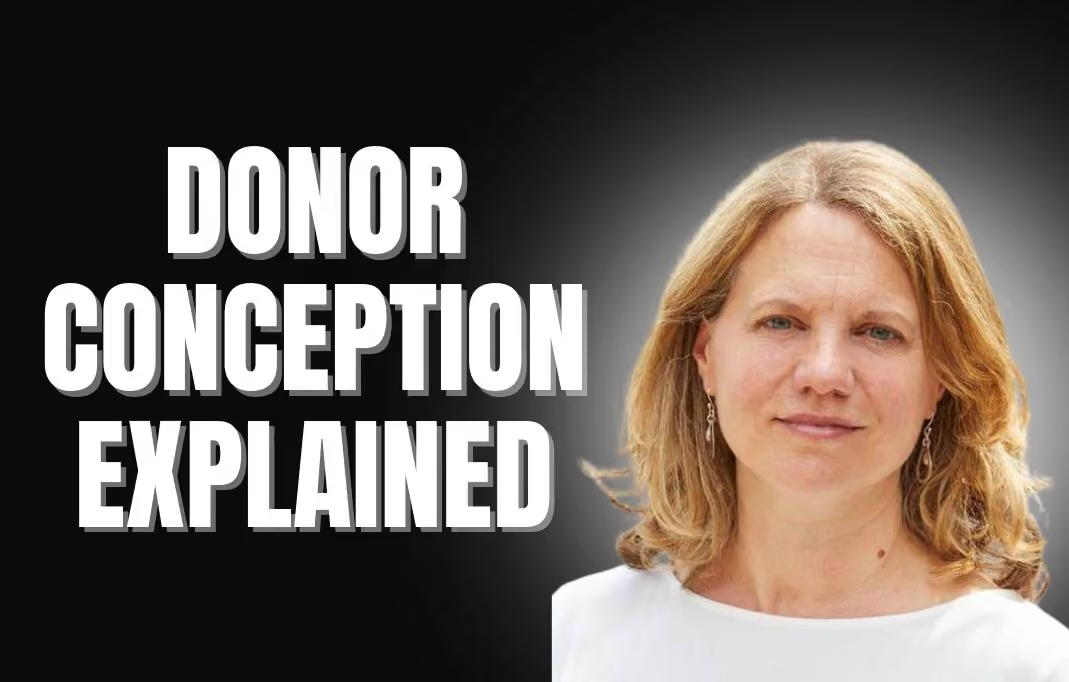
In the original session, Nina Barnsley of the Donor Conception Network discusses common fears among men, grief and genetics, the UK route to donor sperm, identity and consent, imported sperm, talking with children and long-term family support. The session should sit alongside this reference guide so readers can hear the human discussion as well as find precise answers.
Before publication, check this summary and every attributed statement against the recording and obtain Nina Barnsley’s approval for her name, title, biography and any quotation. Do not reconstruct quotations from the short existing page copy.
The most important thing to remember
Donor conception is not simply a substitute vial used at the end of fertility treatment. It is a way of building a family with legal, emotional and identity implications across a lifetime. Give yourself time to grieve, use a licensed clinic, complete consent correctly, plan openness with your child and choose a route you can speak about without shame.
Read Donor Conception Stories from Real Dads and join The Male Fertility Hub community for peer connection.
Related articles
- Beyond Genetics: Navigating Fatherhood Through Donor Conception
- Shaun's Story
- Counselling and Coaching for Male Fertility Challenges
Sources
- HFEA: Using donated eggs, sperm or embryos in treatment
https://www.hfea.gov.uk/treatments/explore-all-treatments/using-donated-eggs-sperm-or-embryos-in-treatment/ - HFEA: Sperm donation and the law for patients
https://www.hfea.gov.uk/treatments/explore-all-treatments/using-donated-eggs-sperm-or-embryos-in-treatment/legal-implications-of-using-donated-sperm/ - HFEA: Becoming the legal parents of your child
https://www.hfea.gov.uk/treatments/explore-all-treatments/becoming-the-legal-parents-of-your-child/ - HFEA: Talk to your child about their origins
https://www.hfea.gov.uk/donation/finding-out-about-your-donor/talk-to-your-child-about-their-origins/ - HFEA: Finding out about your donor and genetic siblings
https://www.hfea.gov.uk/donation/finding-out-about-your-donor/finding-out-about-your-donor-and-genetic-siblings/ - HFEA: Importing and exporting sperm, eggs and embryos
https://www.hfea.gov.uk/treatments/explore-all-treatments/importing-and-exporting-sperm-eggs-and-embryos/ - Donor Conception Network
https://dcnetwork.org/
This article provides general information, not medical or legal advice. Confirm the rules and consent requirements for your circumstances with your licensed clinic and obtain specialist legal advice when needed.