
Download this resouce by completing the form below
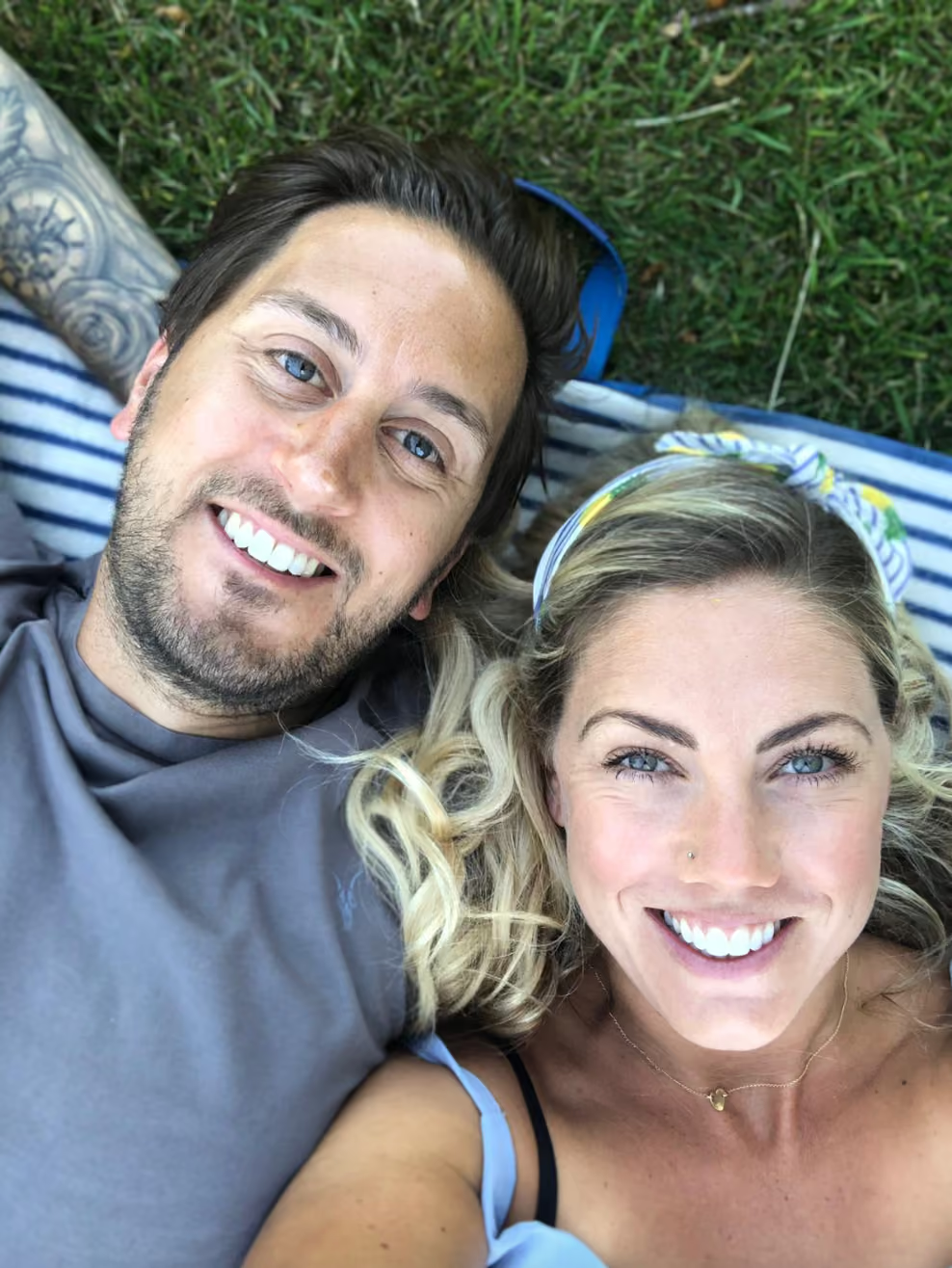
An azoospermia diagnosis can bring shock, further tests and uncertainty about whether sperm can be found or produced. In Shaun’s case, treatment for a varicocele did not lead to sperm appearing in semen, and micro-TESE found no sperm to use. He and his wife Jenna later chose donor conception and became parents to twins. His story is personal, not a prediction of another man’s diagnosis or outcome.
Who am I, and why am I sharing this?
Hi, I’m Shaun. I am a man who was diagnosed with azoospermia.
When it happened, I searched for resources created for men and places where men spoke honestly about shame, confusion, masculinity and fear. I found helpful fertility communities, but very little in which I recognised myself.
That absence is why I began talking. Azoospermia is a medical finding; it is not a measure of worth, sexual ability or masculinity. Knowing that intellectually did not stop the diagnosis affecting my identity, but hearing it earlier might have made the experience less isolating.
How did I find out I had azoospermia?
Jenna and I had tried to conceive for several months before speaking to our doctor. I was referred for a semen analysis, which found no sperm in the sample.
Azoospermia means that no sperm are seen in the semen tested. It does not explain the cause by itself. Results normally need confirmation and further assessment, which can include a medical history, examination, hormone tests, genetic testing and imaging when indicated.
The possibilities and terminology were overwhelming. I wanted one clear explanation and one action that would restore the future we expected.
Read Semen Analysis Results Explained for the difference between a test result and a complete diagnosis.
What happened after my varicocele embolisation?
I had a varicocele embolisation. At the time, I saw it as a relatively contained procedure and allowed myself to believe that we might simply fix the problem and continue, perhaps even conceive without IVF.
That was my hope, not a general promise about varicocele treatment or azoospermia. The likely benefit depends on the type of azoospermia, hormone and genetic findings, testicular function and other individual factors. Men should ask a urologist or andrologist what evidence applies to their diagnosis.
After the embolisation, another semen analysis still found no sperm. The result felt crushing. I understood that, if we could use my sperm at all, it would require a different route.
For an evidence-based overview, read Varicocele and Male Fertility.
Why did fertility treatment make me feel guilty?
I knew Jenna might have injections, scans, egg collection and other procedures because sperm could not be found in my semen. I felt responsible for what her body would have to undergo.
I wondered whether I had failed her and whether she would still see the man she had married. Male infertility became tangled with the belief that I should provide, protect and solve.
Guilt can feel like responsibility, but it is not the same. Neither partner chooses infertility. The useful responsibilities are honest communication, informed consent, shared decisions and practical care. Blame adds pain without improving treatment.
What was micro-TESE like for me?
I underwent microdissection testicular sperm extraction, usually called micro-TESE. During this operation, a specialist examines testicular tissue under magnification to search for areas that may contain sperm.
I woke after the procedure and learned that no sperm had been found. I was also in physical pain and moved around the house awkwardly during recovery.
The emotional result felt final in my circumstances: I would not become a genetic father using sperm retrieved from my testicles. Another man’s chance of sperm retrieval depends on his diagnosis and clinical factors. A story cannot provide a success rate, and micro-TESE should be discussed with an experienced specialist.
Read Micro-TESE Surgery Explained for preparation, possible outcomes and questions to ask.
How did I grieve the loss of a genetic connection?
I felt denial, anger, bargaining, low mood and, eventually, greater acceptance. Those experiences did not arrive in a tidy order. The familiar “stages of grief” should not be treated as a pathway everyone must complete.
What helped was allowing the genetic loss to matter. People sometimes try to reassure donor-recipient parents by saying genetics are irrelevant. That can unintentionally close the conversation. I needed to grieve what I had imagined before I could choose a different route honestly.
Acceptance did not mean liking the diagnosis or never feeling sad again. It meant I stopped spending every day fighting a fact I could not change and began considering the life still available to us.
How did we decide to use donor sperm?
Donor conception moved from an abstract treatment option to our possible route to parenthood. The decision involved more than choosing sperm. We needed to consider:
- Whether both of us were choosing the route freely
- Legal parenthood and clinic consent
- What donor information would be available
- The future child’s access to identifying information
- Genetic siblings and family limits
- How and when we would talk with our children
- How I felt about bonding and fatherhood
Specialist counselling and hearing from donor-recipient parents helped create space for those questions. No man should be rushed into donor conception because his own treatment has ended.
Read Donor Sperm Conception for Men for the current UK process and law.
Did donor conception change how I define fatherhood?
Yes. I began separating genetic contribution from the work and relationship of parenting. Supporting Jenna, attending appointments and making decisions together did not make me less of a partner. Raising a child would not become less real because a donor had provided sperm.
This perspective did not require pretending genetics mean nothing. Our children may have their own questions and feelings about the donor and their genetic origins. My role is not threatened by their right to know their story.
What happened next?
In February 2021, Jenna and I welcomed our twins, Ray and Evelyn, conceived with donor sperm. They are my children, and everyday fatherhood has made the relationship more concrete than the fears I held before treatment.
Love and bonding are built through presence, care, repair, play and responsibility. The arrival of our children did not retroactively make the diagnosis easy. Gratitude and earlier grief can exist together.
Before publication, Jenna and Shaun should confirm that the children’s names, birth month, twin status and donor-conception details may remain public. Their privacy interests change as they grow.
Why did I start speaking publicly?
I began on Instagram as @knackered_knackers and later co-hosted The Male Fertility Podcast with Ciaran. The aim was to give men language, informed conversations and real stories that I could not find after diagnosis.
Public advocacy has helped me, but nobody owes the internet a disclosure. A private conversation with a partner, counsellor, doctor or peer can be equally important.
What would I tell a man newly diagnosed with azoospermia?
- Ask for the result to be confirmed and the possible type and cause explained
- See an appropriate male-reproductive specialist
- Ask which hormone, genetic or imaging tests are indicated
- Do not start testosterone or supplements without clinical advice
- Take someone to appointments or write questions down
- Treat sperm-retrieval statistics as diagnosis-specific, not personal guarantees
- Make room for grief and mental health as well as procedures
- Do not rush a decision about donor sperm or another family-building route
- Remember that the result does not define sex, masculinity or worth
Questions to take to the next appointment
- Has azoospermia been confirmed on an appropriate repeat analysis?
- Is obstruction or impaired sperm production more likely?
- Which hormone and genetic tests do I need?
- Is a treatable factor present?
- What is the realistic purpose and chance of each proposed procedure in my case?
- What are the risks, recovery and alternatives to sperm retrieval?
- If no sperm are found, what support and family-building options are available?
Editorial safeguards before publication
- Obtain Shaun’s approval for the substantive first-person edit
- Obtain Jenna’s approval for details about her treatment and the couple’s decisions
- Reconfirm the children’s privacy and names
- Verify the sequence and clinical terminology from records where possible
- Do not imply varicocele embolisation normally restores sperm in azoospermia
- Do not present grief stages as a universal model
- Add the named clinical reviewer only after review
- Replace the old SEO title and duplicate download H1 in Webflow
The most important thing to remember
Azoospermia can change the route to parenthood and affect the way a man sees himself. Get the result investigated properly, ask what each procedure can realistically achieve and let the loss of a genetic connection be spoken about. If donor conception becomes your route, choose it with time, information and a commitment to openness with the future child.
Join The Male Fertility Hub community if you want to speak with men who understand male infertility.
Sources and further information
- NHS: Low sperm count
https://www.nhs.uk/conditions/low-sperm-count/ - European Association of Urology: Male infertility guideline
https://uroweb.org/guidelines/sexual-and-reproductive-health/chapter/male-infertility - HFEA: Using donated eggs, sperm or embryos
https://www.hfea.gov.uk/treatments/explore-all-treatments/using-donated-eggs-sperm-or-embryos-in-treatment/ - The Male Fertility Podcast
https://podcasts.apple.com/gb/podcast/the-male-fertility-podcast/id1713514767
This is one person’s lived experience and general information. It does not predict another man’s diagnosis, sperm-retrieval outcome or route to parenthood.