
Download this resouce by completing the form below
Fathers are capable of forming deep, responsive bonds with children. Research suggests that becoming and acting as a caregiver can be associated with changes in attention, brain activity and hormones, but biology is not a fixed programme or a test of good fatherhood. Caregiving experience matters: learning a child’s cues, spending time together and sharing ordinary care help build attachment, whether or not parent and child share genes.
Do men have a parental instinct?
“Instinct” is too simple if it means women automatically know how to parent and men do not. New parents of any gender learn through attention, experience, culture, support and the relationship with a particular child.
There are biological systems that support caregiving, but they do not produce one universal feeling or behaviour. Some fathers feel connected during pregnancy, some at birth and some gradually. None of those timelines alone determines whether a person will become a responsive parent.
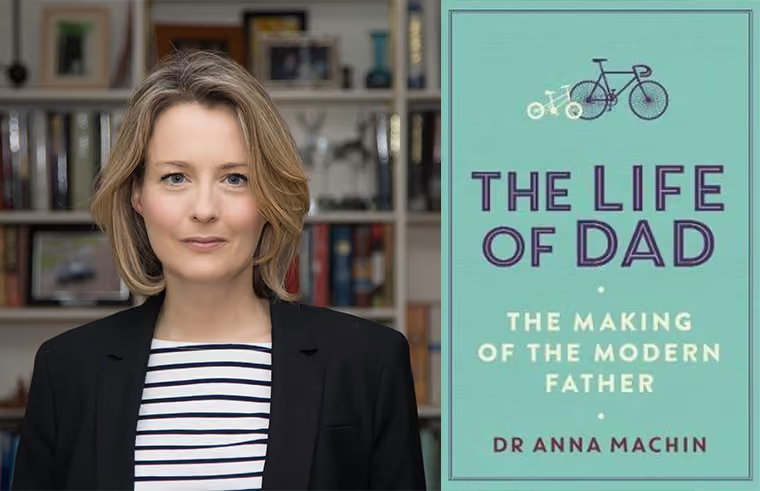
The useful message from Dr Anna Machin’s original interview is that men are not biologically excluded from caregiving. The scientific caution is that no single hormone, brain scan or evolutionary story proves how an individual father will behave.
Does a father’s brain change with caregiving?
Research shows that parental brain responses are sensitive to experience. A 2014 functional-MRI study examined 89 first-time parents: primary-caregiving mothers, secondary-caregiving fathers in heterosexual couples and primary-caregiving fathers in male couples. All groups showed activity across a parental-caregiving network involving emotional processing and social understanding.
Primary-caregiving fathers showed strong integration between these systems, and time spent in direct childcare was associated with connectivity in the fathers’ brains. The study supports brain plasticity and the importance of caregiving experience; it does not identify a single “dad brain” or show that one family structure is biologically preferable.
Brain-imaging studies are generally small, examine group averages and cannot read love or parenting quality from one scan. They are a research tool, not a clinical test for readiness or bonding.
What happens to hormones when men become fathers?
Studies have examined testosterone, oxytocin, vasopressin, prolactin and cortisol across the transition to fatherhood. Findings suggest that some hormone patterns differ between fathers and non-fathers or change across pregnancy and early parenting.
For example, a 2025 longitudinal study followed 51 first-time expectant fathers and 57 men who were not fathers. It reported changes and group differences in testosterone, vasopressin and oxytocin. Lower prenatal testosterone and vasopressin were associated with later self-reported paternal investment, while the rise in oxytocin was not associated with greater involvement or attachment in that study.
This illustrates why “oxytocin is the bonding hormone” is an oversimplification. Hormones vary with time of day, stress, sleep, relationships, behaviour and measurement method. Associations do not prove that one hormone causes caregiving.
There is no healthy-father hormone target. Do not use commercial hormone tests or testosterone treatment to measure or improve bonding. Prescription testosterone can also suppress sperm production, so men who want fertility care should discuss it with an appropriate clinician.
Does biology make fathers care in one particular way?
No. Group-average differences in play or interaction do not prescribe what an individual father should do. The live article says fathers typically provide physical, stimulating play while mothers provide a complementary nurturing role. That framing risks turning research averages into gender rules and overlooking the wide overlap between parents.
Rough-and-tumble play can be enjoyable and may create opportunities to practise boundaries, emotion and physical confidence when the child welcomes it and the adult remains responsive. It is not required for fatherhood, unique to men or suitable in every family or developmental stage.
Fathers can soothe, feed, cuddle, listen, set boundaries, play quietly, handle night care and provide every form of everyday nurturing. Mothers and parents of other genders can engage in active play. The child’s signals, safety and relationship matter more than performing a gendered style.
Why are human fathers discussed in evolutionary research?
Compared with many mammal species, human children depend on adults for an unusually long time and human fathers often contribute substantial direct care, resources, teaching and social connection. Evolutionary anthropology studies how paternal care may have developed within cooperative human childrearing.
These explanations are hypotheses about population history, not instructions for modern families. They cannot tell us that:
- Every biological father will care
- Only biological fathers can perform a paternal role
- A nuclear mother-father household is the single natural family form
- A particular parenting behaviour is fixed by sex
- Genes make somebody a better parent
Human children are raised in diverse networks that may include parents, grandparents, step-parents, adoptive parents, donors, siblings and community members.
Does sharing sperm make someone a dad?
Genetic contribution and parenting are different relationships. A sperm provider may be a parenting father, a donor with no parenting role or somebody absent from the child’s life. A father may be genetic, adoptive, donor-recipient, step, foster, social or intended through surrogacy, depending on family and legal context.
Dr Machin’s line in the original interview captures the distinction:
“A bit of sperm doesn’t make you a dad. What makes you a dad is stepping up and doing the job.”
Check the exact wording and context against the recording before publication. Also avoid using the quote to dismiss the importance that genetics may have for a donor-conceived or adopted person. A child can value genetic information and be securely attached to the father who raises them.
Read Fatherhood After Donor Conception for Shaun’s lived experience.
Can bonding begin before birth?
Expectant fathers may begin forming a picture of the child during pregnancy by attending appointments, talking with a partner, feeling movement, preparing the home or imagining ordinary family life.
Research has found associations between expectant fathers’ brain connectivity, prenatal empathy and later self-reported bonding or parenting. Small studies and self-report measures cannot show that a particular prenatal activity guarantees attachment.
If pregnancy follows infertility or loss, imagining the baby may feel frightening. A father may avoid bonding as protection against another loss. Do not turn talking to the bump or attending every scan into a test of love.
Useful opportunities include:
- Attending appointments when possible and invited
- Learning about pregnancy and newborn care
- Talking about hopes and fears with a partner
- Taking part in practical preparation
- Seeking support for anxiety or previous loss
Connection can begin before birth and can also develop afterwards.
How does a father build a bond after birth?
Bonding is a relationship that grows through repeated, responsive contact. Try:
- Skin-to-skin contact when safe and appropriate
- Feeding involvement that fits the family’s feeding plan
- Nappy changes, bathing, dressing and settling
- Learning different cries and cues
- Talking, singing, reading and eye contact
- Taking regular one-to-one care rather than only “helping” another parent
- Repairing after frustration or mistakes
- Protecting time for rest and support
A 2021 randomised trial of 60 first-time fathers found that three weeks of using a soft baby carrier changed fathers’ brain responses to infant crying compared with a control condition, although it did not change oxytocin levels. A later trial reported stronger bonding scores with frequent father-infant skin-to-skin contact. These studies suggest that contact and care can matter, but they do not create a compulsory formula.
Always follow safe-sleep, feeding and medical guidance. Stop any interaction when the child shows distress or when the activity is unsafe.
What if the bond is not immediate?
An instant wave of love is one possible experience, not a requirement. Birth trauma, sleep deprivation, infant illness, relationship strain, financial pressure, infertility history, depression or anxiety can affect how a father feels.
Start with consistent care rather than judging every emotion. Speak to a GP, health visitor or perinatal mental-health professional if you experience:
- Persistent low mood, anxiety or irritability
- Feeling detached from the baby for a prolonged period
- Loss of interest or pleasure
- Difficulty functioning or caring safely
- Increasing alcohol or drug use
- Frightening intrusive thoughts
- Thoughts of self-harm or harming someone else
Meta-analyses show that depression during pregnancy and the first year after birth also affects fathers. It is treatable, and seeking help protects the whole family.
If you or someone else is in immediate danger, call 999 or go to A&E. In England, urgent mental-health help that is not an emergency is available through NHS 111 online or by calling 111 and selecting the mental-health option. Samaritans can be called free on 116 123.
How can services include fathers properly?
- Address fathers and partners directly rather than treating them as visitors
- Explain pregnancy, birth and newborn care to both parents with consent
- Ask about the father’s mental health
- Include diverse families and non-genetic fathers in materials
- Offer flexible antenatal and parenting education
- Provide opportunities for hands-on care
- Give clear support routes after infertility, loss or traumatic birth
- Avoid assuming caregiving roles from gender
Inclusion should never override the pregnant or birthing patient’s consent, privacy or medical needs. Co-parenting means respecting both people’s roles and boundaries.
What does the research not prove?
The current evidence does not justify claims that:
- Mothers and fathers begin with identical or measurable “instincts”
- A defined hormonal programme prepares every man for care
- Fathers evolved at one precisely established date
- Only a small fixed percentage of mammal fathers care, without defining the behaviour and species sample
- Fathers are biologically designed for rough play while mothers nurture
- Prenatal voice or touch guarantees stronger later attachment
These ideas may arise in a wide-ranging podcast discussion, but the article should distinguish an expert’s interpretation from established evidence. Link to the underlying study where a scientific claim is made and state sample size and limitation when useful.
Questions for a new or expectant father
- What caregiving tasks can I learn and own?
- What helps me feel connected, and what makes me withdraw?
- Am I expecting one dramatic feeling instead of noticing a growing relationship?
- How will my partner and I share care and rest?
- What part of infertility or loss is following me into parenthood?
- Who will I tell if my mood or thoughts become frightening?
About Dr Anna Machin’s original interview
The Male Fertility Podcast episode explores paternal instinct, evolution, hormones, brain change, play, prenatal bonding and the social treatment of fathers. Audio is valuable for hearing Dr Machin’s complete argument; this page provides a more cautious reference layer for search readers.
Before publication:
- Confirm Dr Machin’s current title and biography
- Verify every quotation against the episode
- Invite her to review the edited summary
- Add the specific episode link
- Replace the unsupported or over-precise claims flagged above
- Use inclusive language that recognises adoptive, donor-recipient, step, foster and same-sex-parent families
The most important thing to remember
Fatherhood is neither a sperm contribution nor a biological performance. Men have the capacity to care, and that capacity is shaped through relationship and experience. Spend time in ordinary care, learn the child in front of you and ask for help if bonding or mental health is difficult. A growing bond is no less real than an instant one.
Join The Male Fertility Hub community for peer connection around fertility and fatherhood.
Related articles
- Donor Conception Stories from Real Dads: From Diagnosis to Fatherhood
- Donor Conception for Men Explained with Nina Barnsley
- Counselling and Coaching for Male Fertility Challenges
Sources
- Abraham E, et al. Father’s brain is sensitive to childcare experiences
https://pubmed.ncbi.nlm.nih.gov/24912146/ - Saxbe D, et al. Hormonal changes in first-time human fathers in relation to paternal investment
https://pubmed.ncbi.nlm.nih.gov/40209509/ - Van ’t Veer AE, et al. A soft baby carrier intervention enhances amygdala responses to infant crying in fathers
https://pubmed.ncbi.nlm.nih.gov/34391194/ - Rao WW, et al. Prevalence of prenatal and postpartum depression in fathers: meta-analysis
https://pubmed.ncbi.nlm.nih.gov/31757623/ - NHS: Help for postnatal depression
https://www.nhs.uk/mental-health/conditions/post-natal-depression/
This article summarises developing research. Group-level associations in neuroscience and hormone studies cannot diagnose an individual or determine parenting ability.